
Dr. Raman Chawla, Sudeep R. Nayak, Vinod Kaushik
Global health crises are often considered ‘black swan’ events that drastically reshape our environments and necessitate that communities adapt to the looming threat of future infectious diseases. The challenges encountered during such times have sparked vital conversations around housing policies, including the need for affordable, resilient homes and emergency accommodations to mitigate potential displacement.
Modern architectural planning now calls for features that support quarantine and social distancing, along with adaptable semi-open areas suited for prolonged lockdowns. Key design elements include provisions for remote working spaces, water and air quality control, outdoor interaction zones, vertical space optimization in compact homes, kitchen and food safety, energy efficiency, modular versus fixed layouts, self-sanitizing materials, acoustic control, reliable global connectivity, isolated maintenance access, and private yet socially integrated residential designs. These requirements signal a transformation beyond conventional smart home technologies.
Recent studies indicate a paradigm shift in the conceptualization of pandemic-resilient housing—either through designs adaptable to evolving needs or through preconfigured layouts suitable for predicted scenarios. One highlighted necessity is the incorporation of flexible workspaces to support telecommuting.
Further investigations aligned with sustainable development goals have emphasized several critical design principles:
(a) strategic orientation for optimal natural light exposure through open blinds and windows,
(b) intelligent systems to regulate environmental quality, comfort, and user experience,
(c) integration of green spaces and exercise areas to enhance physical and mental well-being, and
(d) comprehensive waste management systems that protect public health and the environment.
The rapid spread of pathogens, particularly airborne ones, highlights the need for architectural innovations that reduce transmission risks. This includes the integration of designated contaminant management areas equipped with advanced sanitation technologies, dedicated self-isolation rooms, access to green or open-air spaces, and interior zones designed to minimize exposure and transmission risks.
The present study is an attempt to integrate these study designs with new pandemic resilient technologies for an effective and reliable outcome for future habitats. The study focuses on Contaminant Management Space, Self Isolation Space & Technologies for residences enabling it for dangerous threats of future.
Standard Layout : Dual Living Room Concept
The studies revealed that either replaceable wall or permanent structures with variable air flow was found to be essential to design template layout for future habitats. Accordingly, an apartment template layout is designed with two adult bed rooms (B & D4) and one children’s room [D3] (Figure1). The whole layout is divided into five section i.e. [A] Contaminant Management Space; [B] Self –Isolation Space; [C] + [D] = Internal Safe Space; [E] Exterior Space [such as external space next to main entrance (E1 & E7) as well as balcony/ chimney/ children’s play area/ laundry dryer (E2-E6)]. The internal safe space shall have dual living room concept as being practiced earlier in the previous century. It includes “Baithak” or semi-public space [C] for visitors and private area [D]. The internal private area has living room along with kitchen [D2], dining [D1], main bathroom & common laundry space [D5], master bed room [D4], children’s bed room [D3] and direct access to another bed room [B] that is transformable to self isolation space at the time of need. Both rooms are attached in continuity with separation which can be completely separated if required and/or merged with the collapsible wall concept. The semi-public space or first living room [C] can be directly accessed from the contaminant management space corridor without entering into internal space. In a normal life routine, this area provides racks for footwear, hanging of external coats etc. The dual living room concept is an old tradition with direct significance of preventing spread of infections.
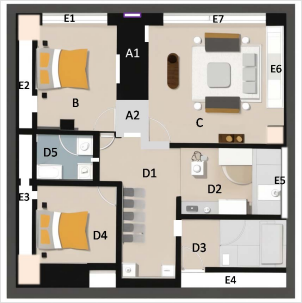
Figure 1: Template Layout: A1 + A2 : Contaminant Management Space; B: Self-Isolation Space; C: Baithak / Living Room-I or Semi-Contaminant Space or Public Meeting/ Party Place; D: Internal Safe Space – D1: Dinner cum- Living Space; D2: Open Kitchen; D3: Bed Room (or Children Room); D4: Master Bed Room; D5: Master 4 Pc Bathroom with Laundry & Drying Space with dual gate – 01 from Master Bed Room while other from D1 side; E: External Spaces for Fresh Air Infusion: E1: External Space attached to Self-Isolation Space; E2: Balcony with gardening for fresh air infusion; E3: Drying Space for Laundry, open gardening space and sitting space balcony for master bedroom; E4: Covered Balcony with external space for playing of children or Elder’s sitting space or Exercise Zone; E5 : Chimney connected to balcony space for exhaust and removal of kitchen air, gas pipeline connection; E6: Balcony designed with space for parties extended area E7: External Space with Baithak receiving exhaust air; 3 Pc: 3 Pc Bathroom attached to bedrooms and 2 Pc: 2 Pc bathroom attached to baithak or living room-1.
Contaminant Management Space (CMS)
CMS space is sandwiched between external and internal environments. It is a permeable zone or buffer area with multiple requirements however limited to UV-C radiation alone as a sterilization system with its own restrictions highlighted in his study. Based on design-technology integration model, an analysis revealed that such confined space require :
(a) clothing management; (b) hand/ body hygiene; (c) waste collection bins; (d) dual door system; (e) collection unit for delivered items; (f) footwear management system; (g) self sanitization ability; (h) fruits and vegetables cleaning/ sanitization (as applicable) and other dynamic requirement(s) as per nature of pathogens. The design layout (figure 1) illustrates two sections of this corridor i.e. A1 & A 2 Section. The initial section (A1) from the main entrance is designed with various components (Table-1) and has direct access to Self Isolation Space [B] and First Living Room or Semi-Public Space [C] ensuring fast evacuation of elders/ children for health care and; “Baithak” concept. A2 is the glass door section just prior to entrance into Internal Safe Space ensuring cleanliness and visualization. The pictorial depiction comprises multiple technological integrations (Table-1).
Table 1: Components of Contaminant Management Space (CMS) & its depiction in design
| Need | Technology/ Design Layout | Implications |
| Compartmentalization | Main Entrance Door & Internal Entrance Door [1] | Prevent contamination/ infections to reach internal area according section A 1 and A2 as well as multiple entry access ensuring safety. Entrance is pre-fixed with viscoelastic gel with anti-microbial coating ensuring prevent of escape of any gas during disinfection procedures [1] |
| Body Hygiene & Clothes Washing | Standing Shower Unit [4] with self-sanitization ability enabled as integrated Poorn Swachh [2] just prior to internal entrance door along with small laundry unit | This unit allows family person to take bath prior to entering and after taking bath, the same can be sanitized using ozonated fog based Poorn Swachh unit. In addition, small laundry fitted for washing of infected clothes as per requirement. |
| Air Flow | Airlocks or design to exhaust internal air outside diluting its contents or Air Sanitization Unit aka Vayu Swachh+ technology [3]. | Air locks are advisable subjected to cost attributes however design with exhaust flow in particular direction ease dilution of pathogens. Vayu Swachh+ sanitize, purify and filter air safe for operations. |
| Hand Hygiene, Fruits & Vegetable Sanitization | Sink with running water enabled with Samgrah Swachh & Tri-Netra Hand Sanitization Unit. Shall be designed with sliding shelf to transfer contents directly into internal environment [5] | This single unit is designed to sanitize hands, clean and sanitize fruits and vegetables etc. |
| Waste Collection | Sanitized Bins using Poorn Swachh Technology enables safety [6] | Bins in this unit with sliding unit from internal space allows solid waste to get collected here with sanitization ability using ozonated fog based technology (Poorn Swachh). This prevents build up of microbes reducing probability of spread of infection for family members or bin collection personnel. |
| Surface Contamination Management | Hydrophobic, closed cell polymer flooring and marble flooring with anti-microbial coating [7-8] | No gaps between flooring with water proofness and prevent build up of microbes when exposed. |
| Clothes & Multi- purpose Items | Tri-netra Multipurpose Disinfection Unit (Ultraswachh Tech) [9] | It has multiple disinfection technologies integrated in single cupboard design unit to neutralize any microbe irrespective of pathogens. Differential systems can be opted as per user’s choice |
| Footwear & other items (with hard surfaces) | UV-C Sanitization Box for footwear & other items [10] | Hard Surface can easily be disinfected in their collection unit itself. |
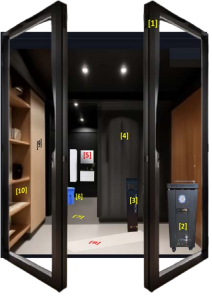
Figure 2: Pictorial Depiction of Contaminant Management Space (CMS) from Internal Entrance of Apartment directly into Internal Safe Space enabled features : (1) Glass Doors with viscoelastic gel + anti-microbial coat tubing; (2) Poorn Swachh – Disinfection Unit – One in Nos; (3) Air Sanitization Unit: Vayu Swachh+ – optional : Stand alone or Wall Hanging Splint; (4) Shower Area with standing unit and small laundry having collapsible wall modifiable as per requirement; (5) Tri- Set Unit with (a) Water Softener; (b) Samgrah Swachh and; Tri-Netra Hand Sanitization Unit; (6) Waste Bin; (7) Surface protected against disinfection & water proof; (8) Marble Flooring or Wooden Flooring Space; (9) Tri-Netra Multi-Purpose Sanitization Unit; (10) Shoe and other items (with hard surfaces) with inbuilt UV sterilization.
Self-Isolation Space
The concept of self isolation space providing pattern & isolation of air flow and its usage based on recent pandemics as illustrated in figure 3 with respect to design layout (figure 1). The exterior unit provides fresh air infusion into their respective rooms or spaces, however the isolation space has inward flow of air from all directions and then exhaust out to the exterior of the apartment via contaminant management space or directly. Another air flow is hot air during cooking that escapes out via the chimney through the attached balcony. The complete apartment is equipped with Vayuswachh+ technology ensuring sanitization of air ensuring no spread of infections or filters out any unexpected gases.
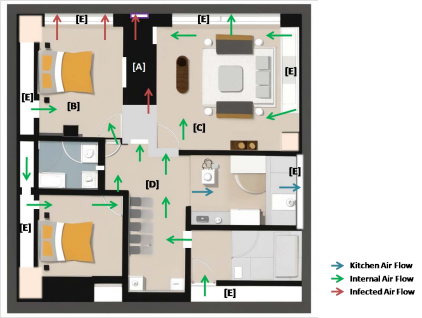
Figure 3: Template Layout: Air Flow : Green Directions illustrate design of air flow from [I] C: Semi Contaminant Space towards A1: Contaminant Management Space or E7: Exterior phase; [II] D: Internal Safe Space towards B: Self Isolation Space and/ or A2/A1: Contaminant Management Space; [III] Kitchen Air Flow while cooking or otherwise towards E5 exterior space.
The numerous technologies surfaced time-to-time accordingly, following attributes can be assigned to this part of habitat: (a) With their attached bathroom; (b) large enough to accommodate > 1 or 02 personnel; (c) separate air conditioning with external duct in outside environment; (d) switch off button if whole building has HVAC controlled system; (e) Moderate size laundry & drier; (f) Telecommuting system; (g) Non-carpet wooden or marble flooring as applicable; (h) Microwave & Heating Station; (i) Air flow separated from main residence such that humidity and directional air flow towards outside; (j) Open access space isolated from main residence; (k) glass separation with living room & (l) direct emergency entrance to contaminant space etc. Many other requirement(s) specific to pandemic are applicable. The components or technologies that can be integrated into such space are given in Table 2.
Table 2: Self Isolation Space
| Need | Technology/ Design Layout | Implications |
| Compartmentalization | Glass Separation | Prevent building up of depression or isolation from other members, can enjoy day-to-day routines with direct visual/ audible access to living room. |
| Large Size | Standard size Master Bedroom is applicable with atleast 01 pre-fitted and 01 additional working unit using micro-designing | Elders’ room in joint families; Guest room in nuclear families in parallel to contaminant space allows it to be suitable for self-isolation space. |
| Air Conditioning, Humidity and Air Flow | Separate A/C and air flow towards external space & switch off button from central A/C | Prevent build up of pathogens in due course of time |
| Specialized Bathroom | 3 Pc bathroom set with standing shower unit and laundry machine/ dryer for 4-5 clothes. | This will ensure cleanliness and hygiene as well as self management ability |
| Extended Balcony with greenery | Separate Balcony with open access to clean air and greenery | Prevent depression of isolated space as well as aid treatment of the patients |
| Direct Access to Contaminant Space | Design component to allow access to contaminant space directly for medical evacuation | In case of medical evacuation it is preferable to have direct access to this room will ensure safety of other residents |
| Medical Aid and other Accessories | Telecommunication for working/ telemedicine fulfilment; allocated space for putting I/V; oxygen concentrator (Ucchvasita) or any other equipment if required etc. | Direct access to doctors via telemedicine, oxygen can become essential requirement helps in faster treatment with continuous touch of medical professional help. |
| Special Beds | Viscoelastic Gel with anti- microbial coating bedding on preferably steel based modulated beds. | Ease of disinfection unlike foams that traps pathogens and Steel beds are cleanable with standard disinfectants. |
| Non-carpeted Flooringwith heat sanitization equipment | Wooden and preferably marble flooring and room shall be equipped with heating mops and Poorn / Vayu Swachh equipment(s). | Prevent build up of microbes, and aid faster recovery in this clean and sanitized environment |
The telemedicine plays a significant role to support the patients in self isolation space as an analysis of telehealth care is an important adjuvant to standard health care delivery. Post-pandemics many Start ups initiated such services however, an integration into standard information exchange, authentication of services offered, monitoring and quality assurance is needed under a comprehensive framework with direct intervention of government.
Technology Enabled Residences
The design and technologies integration is a key factor towards residential resilience against future pandemics. It includes adoption of new enhanced sanitization practices as part of new / adapted culture; in-built technologies with least/ no recurring supplies and immediate impact on residences with elders. Table 3 provides a glimpse of technologies, their suggested site of deployment and implication. The list of products/ their adaptations is part of Ultraswachh technological initiatives of DRDO. Figure 4 illustrates various suggested sites for multiple technologies on design layout.
Table 3: New Pandemic Resilient Technologies
| Technology | Suggested Site | Implications |
| Tri-Netra Multipurpose Disinfection Unit | Contaminant Management Space | Disinfect clothes and other materials with least recurring supplies |
| Advance Cupboards with PPE Disinfection System | In Built Cupboards of Residence | Ozonated Fog based sanitization ensures disinfection of items |
| Vayuswacch+ Split Units | Separate Units for each room ensuring sanitized air flow in each confined space providing microbial free indoor air | Safety against both extreme pollution and pathogens, neutralize pathogens irrespective of origin |
| Vayuswachh-switch-overUcchvasita Unit | Designated Self- Isolation Space | Use it air sanitization space in normal day routine and if pandemic happens shift to oxygen concentrator if required. |
| Samgrah Swachh & Tri-Netra Hand Sanitization System | Contaminant Space & Kitchen as well as designated Tri-netra Hand Sanitization Unit. | Fitted to main supply with dual provisions: (a) softness of water and; (b) ozonated water supply for fruits and vegetable sanitization & hand hygiene units without any fire hazards |
| UV-C Sanitization Box | Contaminant Space and Self-Isolation Space | Hard items disinfection in which porosity is least or not present like footwears, purses, currency etc. |
| Viscoelastic Gel with Antimicorbial Coating | Self-Isolation Space | Beds shall be easily disinfected and its pressure dispersion with extreme comfort aid better sleep for all in day to day routine. |
| Advance Showers with self sanitization ability | Contaminant management Space | These showers have in built poorn Swachh technology ensuring self sanitization of the shower unit. |
| These showers have in built poorn Swachh technology ensuring self sanitization of the shower unit. | Portable – for disinfecting homes | Use it daily for disinfecting homes using ozonated fog. |
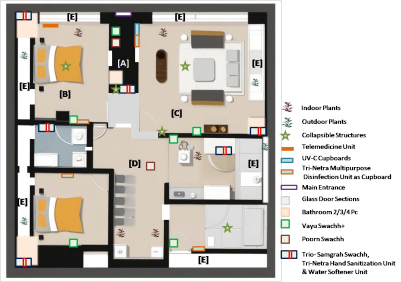
Figure 4: Technological Integration Layout
Challenges Ahead
The technology enabled residence model is effective for urban town houses, apartments, with 02/03 and above bed rooms with a minimum of 03 bathrooms. However, these expensive suits are fulfilling a highly urbanized society. The main challenge is to develop 01 bed room apartments of nuclear families (with maximum of 02 adults/ 02 children) into adjusted models with technological utilization to its maximum. Another challenge is to develop the building ecosystem, town house management ecosystems and independent households. The transition will be slow though if it is integrated with solar energy models, On-Site waste management models, water circulation & reuse model; community based vertical farms, balcony green houses, urban farming with natural air purification concepts and many others that will surface in due course of time. It is an initiation of a new era for future habitats and we should expect technological marvels in coming decades ahead.
Authors Biography
Raman Chawla,Sudeep R. Nayak, Vinod Kaushik are working in Division of CBRN Defence,Institute of Nuclear Medicine and Allied Sciences, Delhi

