
Dr Keshavi Killi, Dr Tejeet Reddy Mettu
Cancer has become a significant public health concern in India, with a rising prevalence among women. Various factors such as socio-demographics, lifestyle choices, and limited access to healthcare contribute to this growing burden. Major cancers affecting women include breast, cervical, ovarian, and uterine cancers, with increasing incidence and mortality rates. Despite advances in medical technology, challenges in cancer care persist. Awareness about prevention and early detection remains low, particularly in rural areas, leading to delayed diagnoses. In addition, treatment adherence continues to be a major barrier to improving survival outcomes. Women’s knowledge, attitudes, and practices (KAP) regarding cancer are crucial in shaping these trends. This article explores the factors influencing cancer prevalence in Indian women, highlighting the associated risk factors, importance of improving awareness, early detection, and treatment adherence to enhance cancer control strategies and overall outcomes.
Trends in cancer prevalence in Indian women:
- Breast Cancer: Breast cancer is the most common cancer among Indian women, showing a steadily increasing incidence, particularly in urban areas. It has overtaken cervical cancer as the leading cause of cancer in women in the past two decades. A 2020 study from the Indian Council of Medical Research (ICMR) highlighted a 1.3% annual increase in breast cancer prevalence among women, with urban areas showing higher rates due to lifestyle factors.
- Cervical Cancer: While cervical cancer has traditionally been the most prevalent form of cancer in rural India, its incidence has been gradually declining in urban regions, partly due to increased awareness and the introduction of the HPV vaccination. However, rural areas still report high rates, attributed to lack of screening and preventive measures.
- Ovarian and Uterine Cancer: The prevalence of ovarian and uterine cancers is also rising, with risk factors such as age, hormonal treatments, and genetic predisposition contributing to this increase. Women in urban areas, particularly those with higher socioeconomic status, are more likely to develop these cancers due to lifestyle factors.
Factors associated with cancer prevalence in women
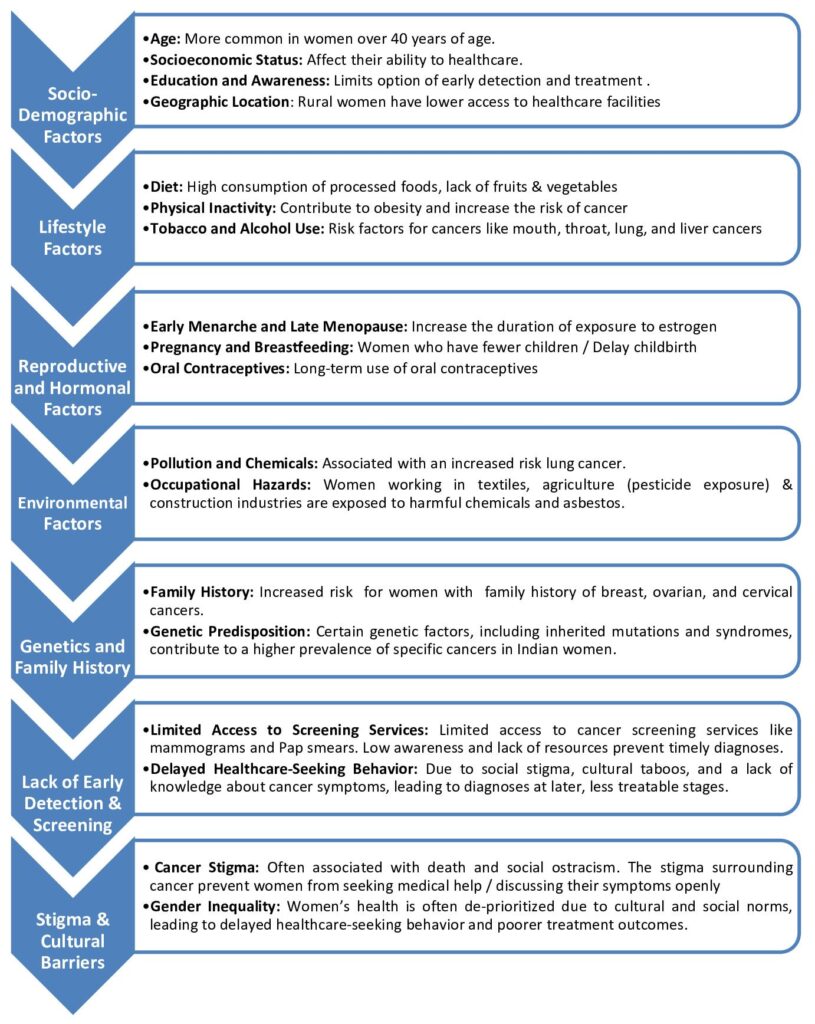
The prevalence of cancer among Indian women is influenced by a combination of socio- demographic, lifestyle, reproductive, environmental, and cultural factors (depicted in Fig.1). To address the rising burden of cancer, it is crucial to identify these factors and address them through comprehensive strategies that can help improve early detection, treatment, and outcomes for women with cancer in India.
Knowledge, Attitudes, and Practices (KAP) regarding cancer in women
Knowledge: Studies reveal a significant gap in knowledge about cancer risk factors, early warning signs, and preventive measures, particularly in rural areas. While urban women generally have better access to health information, rural women remain largely uninformed about essential screening methods like mammograms, Pap smears, and HPV vaccinations. Despite efforts by public health campaigns and NGOs to raise awareness, understanding of cancer risk factors and the importance of early detection remains limited.
Attitudes: Cancer is often surrounded by fear and stigma, especially in rural areas, where many women view it as a fatal disease. This leads to a preference for traditional or alternative treatments over conventional medical care. In conservative communities, there is also a reluctance to discuss cancer openly with family members. Many women underestimate their personal risk of developing cancer, primarily due to a lack of education or the belief that it is a distant possibility. While attitudes towards seeking medical help are improving, challenges remain in underserved regions, where healthcare access and trust in medical professionals are still limited.
Practices: Regular screening practices, such as breast self-examinations, Pap smears, and mammography, are not widely adopted among women in India. A secondary analysis of National Family Health Survey in India (2019-21) data among Indian women aged 30 to 49 found that only 2.0% had ever undergone cervical cancer screening, with urban women screening at 2.4% compared to 1.8% in rural areas. The uptake of HPV vaccination remains low due to lack of awareness, high costs, and misconceptions. Many women delay seeking medical help until symptoms become severe, often resulting in late-stage diagnoses. Socioeconomic factors and gender-based healthcare prioritization further contribute to these delays. Additionally, urbanization has led to lifestyle changes, such as increased consumption of processed foods and sedentary habits, which are known cancer risk factors.
To address the gaps in knowledge, attitudes, and practices regarding cancer among Indian women, efforts must focus on community-based education, reducing stigma, improving access to affordable screening services, and promoting early detection. Integrating these initiatives into primary healthcare systems can lead to better outcomes and more timely interventions.
Strategies to enhance cancer treatment and adherence
Patient Education and Counseling: Healthcare providers increasingly focus on educating patients about the importance of completing cancer treatment. This includes addressing misconceptions, explaining side effects, and emphasizing the benefits of adherence to therapy. Counseling services also help manage the emotional and psychological burden of cancer treatment.
Financial Support Programs: Several government and non-government initiatives are working to reduce the financial burden on cancer patients. These programs include subsidies, free or low-cost treatments, and insurance schemes to help alleviate the costs associated with cancer care, thereby improving adherence.
Use of Technology: Telemedicine and mobile health apps are being utilized to remind patients about appointments, medication schedules, and follow-up visits. These tools can help increase adherence by providing regular reminders and offering emotional support through virtual counseling.
Community and Peer Support: Peer support groups and cancer survivor networks play a significant role in improving treatment adherence. These groups offer emotional support, share experiences, and encourage women to remain committed to their treatment regimen.
Simplification of Treatment Regimens: Efforts to simplify cancer treatment regimens, such as reducing the frequency of visits or introducing oral therapies, are helping to improve adherence. Convenience is a critical factor in ensuring that women remain consistent with their treatment cycles.
Integrated Care Models: Healthcare systems are increasingly adopting integrated care models where multidisciplinary teams, including oncologists, nurses, counselors, and social workers, work together to provide holistic care to cancer patients. These teams address both the medical and psychosocial aspects of cancer treatment, promoting better adherence.
In conclusion, cancer among women in India is an escalating public health challenge, particularly with the rising incidence of breast, cervical, and ovarian cancers. The increasing prevalence, especially in rural areas, is driven by a complex interplay of socio-economic, cultural, and lifestyle factors. Women’s knowledge, attitudes, and practices (KAP) regarding cancer significantly influence early detection and treatment adherence. To improve outcomes, a holistic approach is essential, encompassing patient education, financial assistance, and psychosocial support. Public health campaigns must focus on reducing misconceptions, promoting early detection, and encouraging regular screenings. Additionally, improving access to affordable healthcare and addressing the stigma surrounding cancer treatment can enhance adherence and outcomes. Strategies should prioritize raising awareness, ensuring equitable access to care, and providing comprehensive support to overcome barriers, particularly for women in rural communities.
Authors biography
Dr Keshavi Killi is a Duty Medical Officer(DMO), Kamineni Cancer Centre, Kamineni Hospitals, Hyderabad, India., Dr Tejeet Reddy Mettu is a Casualty Medical Officer(CMO), Narayana Medical College and Hospital, Nellore, Andhra Pradesh, India.

