

Few places in the world stir up as much mystique around money as Switzerland—a lesson I absorbed firsthand during an early-career internship at CERN, where opening a Swiss bank account seemed routine for expats, but back home, it would have raised plenty of eyebrows. For many in India, a Swiss account signified ultrarich privilege and secrecy, not a paycheck or stipend. Living in Geneva, surrounded by leafy boulevards and discreet banks, I found myself in a peculiar limbo—an expat among many, but rarely meeting the so-called “Swiss Swiss” or the globally mobile millionaires who, as I later learned, populate this city’s hidden world.
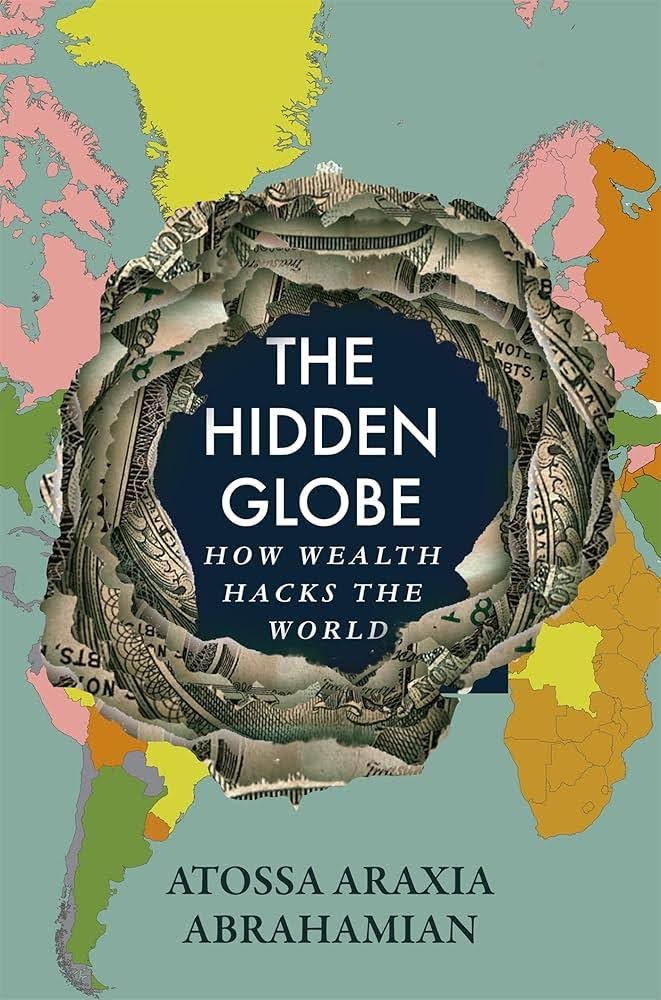
Atossa Abrahamian’s “The Hidden Globe” unpacks this sense of mystery and reveals how money flows far more freely than people or even goods. The author, herself with transnational roots, investigates how the laws of the land are creatively circumvented by the wealthy and powerful. Through her journalistic lens, Abrahamian maps a parallel world composed of freeports, offshore havens, charter cities, and corporate-controlled micro-jurisdictions, all designed to help the world’s richest individuals and organizations escape regulation, scrutiny, and taxation.
I discovered this book through the newsletter of Parag Khanna, whose work I have followed on the future of map of the world. Parag writes about future trends and coincidentally at one occasion I have shared the opportunity to even contribute to a book together with Parag. So, seeing this title in the newsletter spiked my curiosity and I had to read it.
The book’s journey begins in Switzerland’s mountainous cantons, relating their historical role as inventors of sovereignty for sale—first by renting out mercenary fighters, then evolving into a landscape littered with secretive bank accounts and legal fictions. Abrahamian traces this idea well beyond the Alps: she chronicles how entire cities change hands, how companies relocate to minimize taxes, and how priceless works of art move through freeports—literal warehouses exempt from local jurisdiction, where the provenance and ownership of masterpieces can be obscured by the ultra-wealthy.
What resonated deeply with me is how “The Hidden Globe” connects these global phenomena to the places and institutions I encountered as a young professional in Switzerland. Abrahamian’s Geneva emerges as the book’s axis: a hub where humanitarian ideals and financial secrecy coexist, where the international order’s keepers walk the same streets as those who quietly hack it for gain. This city—and by extension, the book—poses tough questions about fairness, transparency, and the true nature of borders in the digital and financial age.
As we navigate an era of dramatic geopolitical uncertainty, with wealth and populations on the move, “The Hidden Globe” is an illuminating guide for anyone keen to understand the forces shaping today’s health, economic, and social systems. Abrahamian does not resort to easy finger-pointing; instead, she sketches a nuanced landscape peopled by consultants, economists, and policymakers whose actions have consequences felt far beyond hidden vaults and distant boardrooms.
In summary, this book opens a vital window into the architecture of the “hidden globe” that quietly determines who wins and loses in the globalized world. For readers of InnoHEALTH—especially those working in global science, public policy, or international organizations—Abrahamian’s investigation is not just timely; it’s essential reading to grasp the invisible infrastructure that shapes both opportunity and inequality today.

