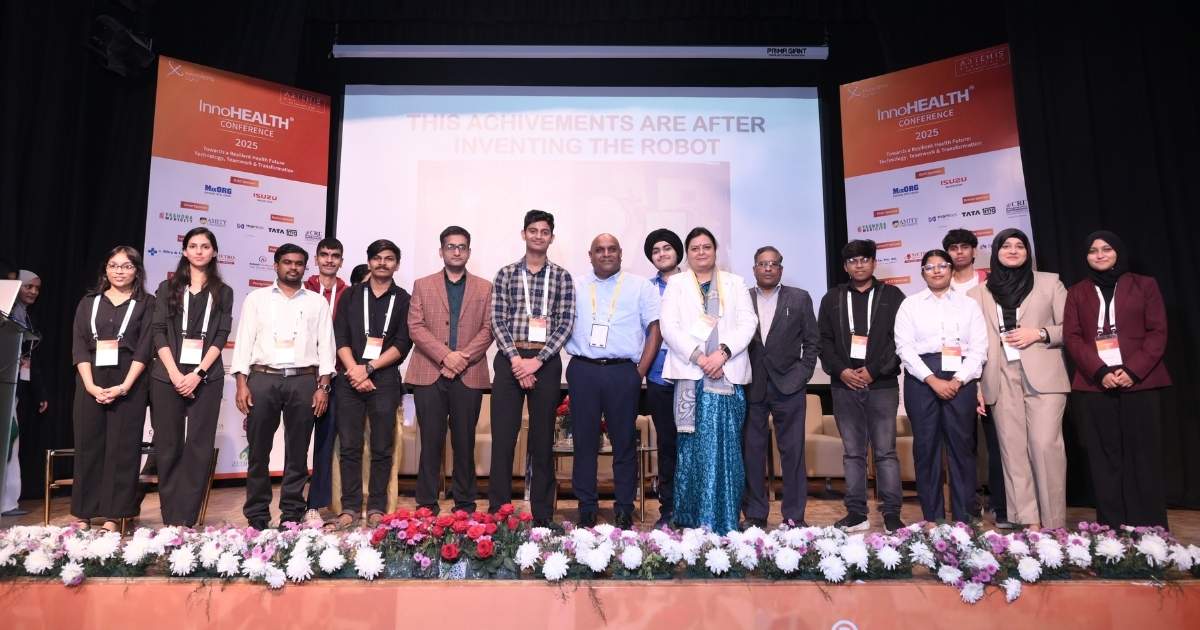
The conference concluded on a high-energy note with the Young Innovators Awards, a session dedicated to celebrating emerging innovators who are applying technology, engineering, and clinical insight to solve pressing healthcare and public health challenges. Guided by a distinguished jury comprising Dr. Tapan Shah, Flt. Lt. Saras Malik, Dr. Saurabh Gupta, and Mr. Sanjeev Kothari, the session showcased a diverse range of ideas—from clean air solutions and medical devices to artificial intelligence and assistive robotics.
The winning innovation was presented by Tanjot Singh, founder of the youth-led startup Pranavya. His project focused on developing a bio-based air filtration system designed to offer a sustainable and affordable alternative to conventional HEPA filters. Using layers of washable polyester, cotton, woolen felt, activated charcoal, and UVC technology, the system aims to significantly reduce particulate matter while minimizing plastic waste and carbon footprint. The jury appreciated the clarity of the problem statement and the potential scalability of the solution, while also encouraging further work on disposal and reuse of captured pollutants.
Arokia Raj, a senior nursing officer and India’s first nurse medical device utility patent holder, presented a highly oxygenated aerosol control combo device developed during the COVID-19 pandemic. The innovation integrates oxygen delivery, nebulization, sputum collection, and aerosol containment into a single semi-closed system, aimed at protecting healthcare workers during airborne disease management. The jury recognized the strong clinical insight behind the device and discussed its future potential, while emphasizing the need for further validation, cost analysis, and large-scale deployment studies.
Another notable presentation came from Aarya Deshpande and his team, who introduced an AI-powered brain tumor screening platform capable of classifying MRI scans, segmenting tumors, and generating structured reports. The system aims to reduce diagnostic delays, particularly in underserved areas, by assisting clinicians with faster triage and decision support. While the jury acknowledged the ambition and integration of multiple AI components, they encouraged deeper clinical validation and clearer differentiation between integration and true technological innovation.
From NIT Raipur, Ananya Biswas and Achutananda Biswas presented a wearable soleus muscle pump device designed to improve venous return in individuals who sit for prolonged hours. Targeted at office workers and long-distance travelers, the device aims to reduce discomfort and swelling associated with poor circulation. The jury commended the practical intent but advised caution in making strong clinical claims without robust physiological and trial-based evidence.
The final presentation was delivered by Ganpati K.G. from Kerala, who showcased a prototype of a human-following robot intended to assist elderly individuals by carrying loads such as shopping carts. Built using basic sensors and microcontroller technology, the prototype demonstrated affordability and accessibility, with future plans for AI-based person identification. The jury appreciated the effort and encouraged further development toward real-world usability in crowded environments.
Announcing the results, the jury emphasized that innovation is driven not by age or resources, but by curiosity, perseverance, and the courage to transform ideas into working models. Tanjot Singh was declared the overall winner, while Arokia Raj, Ganpati K.G., Ananya Biswas and Achutananda Biswas and aarya Deshpande’s team (BIT MISFIT) were recognized for their impactful contributions. The session closed with an inspiring message: the future of healthcare innovation is already taking shape, led by young minds willing to challenge the status quo and build solutions that matter.