Pinaki Singh
Nobody asks what happens between pandemics. We obsess over the ones that make headlines, the paralysing fear of a novel virus, the scramble for vaccines, the grief. But quietly, beneath all of that, there is a question epidemiologists lose sleep over: why do outbreaks seem to arrive in clusters? Why does one outbreak’s smoke barely clear before the next fire is set?
In May 2026, the WHO declared the ongoing Ebola outbreak in the Democratic Republic of the Congo and Uganda a Public Health Emergency of International Concern, citing rising cases, cross-border spread, and uncertainties around the epidemic’s scale. At the same time, public health authorities are investigating a cluster of Hantavirus (Andes virus) cases linked to cruise ship passengers.
And this is not new. Outbreaks rarely emerge in isolation. Mpox appeared while COVID-19 was still reshaping societies. Ebola resurged while the world was still counting pandemic losses. For anyone paying attention, there is a structural pattern here; something the world has been building toward for decades.
The Infrastructure of Spillover
Most dangerous emerging viruses do not appear from nowhere. They come from animals, through zoonotic transmission, when pathogens cross from animals to humans. Ebola, Hantavirus, Nipah, SARS, and COVID-19 all emerged through spillover events, where a pathogen adapted to one species found an unexpected doorway into ours.
Over the past century, several interconnected forces have increased the likelihood of pandemics:
- Increased global travel and interconnectedness
- Rapid urbanisation
- Changes in land use
- Expansion into natural ecosystems
- Intensive livestock farming and wildlife exploitation
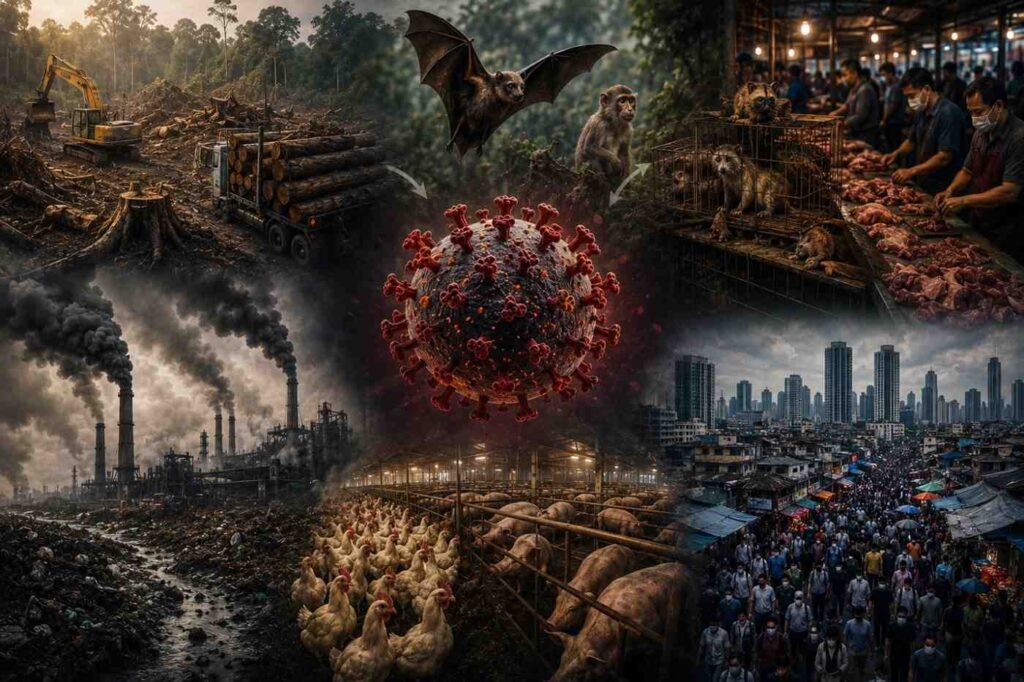
Every road cut through a forest, every wet market, every expansion of human activity into wildlife habitats becomes a negotiation with the natural world.
Spillover risks are not evenly distributed. Higher-risk regions include:
- China
- India
- West and Central Africa
- The Amazon Basin
Key drivers include:
- Bushmeat hunting and animal-based traditional medicine practices
- Logging and natural resource extraction
- Expansion of roads into wildlife habitats
- High levels of biodiversity and animal-human interaction
When outbreaks appear in compressed timeframes, we are often witnessing the consequences of decades of encroachment, movement, and population density coming due all at once.
Spark and Spread: Two Levers, One Fire
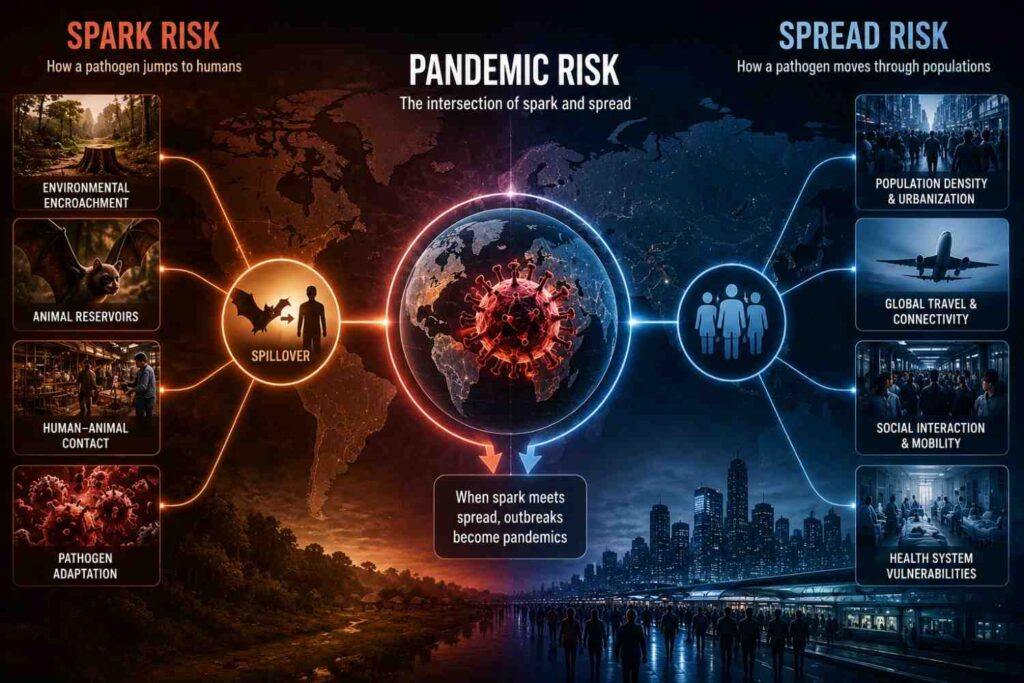
Epidemiologists often think about outbreak risk through two lenses: spark risk and spread risk. Pandemic risk is shaped by both where a disease is likely to emerge and how easily it can move through human populations.
Spark risk is about proximity: how often humans come into contact with animal reservoirs carrying novel pathogens. Spread risk begins after that first contact, and this is where modern life becomes a liability.
Several factors amplify the spread:
- Dense urban populations and overcrowded settlements
- Social inequality and poverty, which increase vulnerability
- Global travel and interconnected transport systems
The Hantavirus cluster being investigated illustrates this well. The Andes virus, one of the few hantaviruses with documented human-to-human transmission, appeared on a cruise ship carrying passengers across multiple countries. In such settings, spread risk multiplies rapidly. Pathogens do not need extreme contagiousness to spread globally; they need mobile hosts and delayed detection.
Before the Guidelines, There Is Us
Public health responses are powerful, but they are inherently reactive. The most meaningful window for interruption exists before official guidance arrives.
Reducing outbreak risk often depends on simple measures:
- Limiting contact with disease reservoirs
- Maintaining clean living and working spaces
- Practising hand hygiene
- Seeking healthcare promptly when symptoms appear
- Providing accurate travel and contact histories
These are not dramatic interventions, but they shorten diagnostic delays and strengthen surveillance systems. There are both structural and human explanations for why epidemics appear to occur in clusters. We have spent decades building conditions that favour spillover and spread, but the speed at which outbreaks escalate still depends on behaviours and decisions made long before any emergency declaration.