Dr. Deepak Samuel, Senior Scientist at the National Centre for Sustainable Coastal Management (NCSCM), Chennai was interviewed by Dr. Debleena Bhattacharya, Associate Editor of InnoHEALTH Magazine. He discussed India’s coastal wetlands, focusing on key challenges, climate change impacts, and pathways toward sustainable and resilient coastal ecosystems.

In your view, what is the current status of coastal wetlands in India, and what are the most pressing threats they face today?
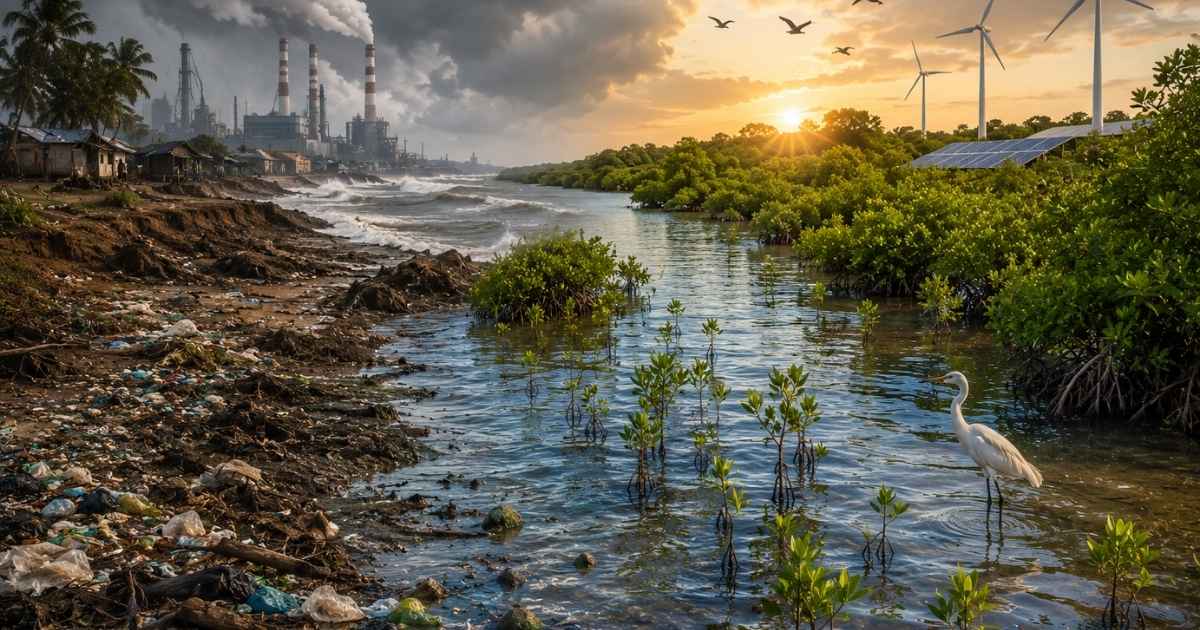
India’s coastline now extends over 11,000 km, supporting highly productive coastal wetlands such as mangroves, estuaries, lagoons, mudflats, and salt marshes, that provide critical ecosystem services such as carbon sequestration, shoreline stabilization, biodiversity support, fisheries productivity, and water purification, while sustaining the livelihoods of over 250 million people living within 50 km of the coast.
According to the National Wetland Atlas (SAC, 2011), India has approximately 15.3 million hectares of wetlands, of which around 4.1 million hectares are coastal wetlands. Mangrove forests alone cover about 4,975 sq km, representing roughly 3% of the world’s mangrove cover (FSI, 2021).
Urban expansion, industrialization, pollution, climate change, and unsustainable development practices (land conversion for aquaculture, ports, urban development, and infrastructure projects) are some primary threats that affect coastal ecosystems. Cities such as Mumbai, Chennai, and Kochi have witnessed extensive wetland reclamation for housing, ports, and industrial zones. The Central Pollution Control Board (CPCB) estimates that India generates over 72,000 million litres per day (MLD) of sewage, of which only about 30–35% is treated.
How is climate change altering coastal ecosystems, and what adaptation strategies are proving most effective?
The Intergovernmental Panel on Climate Change projects that global sea levels could rise by 0.5–1.0 m by 2100, threatening low-lying coastal ecosystems such as mangroves and salt marshes through coastal erosion, wetland submergence, and saltwater intrusion into freshwater systems. This is already evident in the Sundarbans where several islands have disappeared while increasing cyclone intensity in the Bay of Bengal, including events such as Cyclone Amphan, along with rising ocean temperatures and changing ocean chemistry. It is significant to note that coastal ecosystems such as the mangroves are seeming to have migrated landward. The “Sundari mangrove trees” Heritiera fomes named after the Sundarbans are greatly affected by the lack of proper supply of freshwater from upstream because of damming and the impact of seawater intrusion.
Could you elaborate on the role of Integrated Coastal Zone Management in strengthening resilience along India’s coastline?
India’s Integrated Coastal Zone Management Programme (ICZMP) was piloted to promote sustainable coastal resource management, climate resilience, and ecosystem conservation in selected coastal regions. The programme was implemented by the Ministry of Environment, Forest and Climate Change with support from the World Bank in three pilot states
(i) Gujarat (Gulf of Kachchh),
(ii) Odisha (Gopalpur–Chilika coast), and West Bengal (Digha-Sankarpur coast and Sagar Island),
focusing on coastal ecosystem restoration, shoreline protection, pollution management, and livelihood support for coastal communities. Under this initiative, more than 10,000 hectares of mangroves have been restored, coastal vulnerability mapping and monitoring systems have been strengthened, and the programme supported and is supporting the implementation of the Coastal Regulation Zone Notification(CRZ), which regulates development activities along the country’s coast.
The increase in adopting nature-based solutions such as constructed wetlands, Green coastal infrastructure (GCI) and decentralized wastewater treatment systems offers promising opportunities for ecosystem restoration while improving sanitation and public health.
What policy or institutional reforms are needed to improve long-term coastal sustainability?
India has The Coastal Regulation Zone Notification 2019, issued by the MoEFCC and this plays a key role in conserving and protecting India’s coastal ecosystems by categorizing coastal areas based on ecological sensitivity and regulating development accordingly.
Ecologically fragile habitats such as mangroves, coral reefs, sand dunes, turtle nesting grounds, and other coastal wetlands fall under CRZ-I (ESA – Ecologically Sensitive Areas), where development activities are largely restricted to prevent ecological degradation. The notification also requires coastal states to prepare Coastal Zone Management Plans (CZMPs), incorporates hazard line mapping to guide safe and sustainable development, and promotes protection of coastal biodiversity while allowing livelihood activities that are compatible with ecosystem conservation.
Besides the CRZ Notification, other acts that support coastal conservation and protection include:
Wildlife Protection Act 1972 – Protects wildlife species and enables creation of protected areas, including marine habitats.
Biological Diversity Act 2002 – Conserves biodiversity and regulates sustainable use of biological resources.
Environment Protection Act 1986 – Umbrella law enabling environmental and coastal protection regulations.
Forest Conservation Act 1980 – Regulates diversion of forest land, protecting mangroves and coastal forests.
Wetlands (Conservation and Management) Rules 2017 – Provides protection and management framework for wetlands (including coastal wetlands).
How can scientific research, technology, and community participation be better integrated into coastal governance?
The Coastal Regulation Zone Notification 2019 provides the regulatory framework for protecting ecologically sensitive coastal areas, while Coastal Zone Management Plans translate these regulations into spatial plans at the state level. The maps that are prepared clearly demarcates sensitive areas, permissible and prohibited activities. Scientific research supports evidence-based decisions on coastal processes, biodiversity, and climate risks.
Technologies such as remote sensing, GIS, and coastal monitoring systems enable continuous assessment of shoreline change (including erosion and accretion), habitat health, and pollution abatement. Equally important is community participation through stakeholder consultations, citizen science, and inclusion of traditional ecological knowledge, ensuring that conservation strategies also support sustainable livelihoods and adaptive coastal management.
The Critically Vulnerable Coastal Areas (CVCA) under the CRZ 2019 Notification is a participatory approach that engages local communities to identify climate risks, vulnerabilities, and adaptive capacities, strengthening resilience and ensuring locally informed, inclusive coastal adaptation and planning strategies. This is one good initiative besides communities participate in forest management and biodiversity conservation through Joint Forest Management, National Afforestation Programme, and Green India Mission, promoting community-led plantation, protection of forest resources, restoration of degraded lands, and conservation of local biodiversity through village institutions and participatory governance.
The Biodiversity Management Committee’s (BMC) established by the National Biodiversity Authority (NBA) promotes community-based biodiversity conservation by documenting local biological resources, prepare People’s Biodiversity Registers, and support sustainable use and conservation at the village and municipal levels.
Recent conservation initiatives have given strong impetus to protecting coastal sacred groves in India, recognizing their role in conserving biodiversity, traditional knowledge, and culturally significant ecosystems.
If effectively implemented, these institutional mechanisms can significantly strengthen coastal governance by integrating scientific knowledge, regulatory frameworks, technological tools, and community participation to ensure sustainable management, biodiversity conservation, climate resilience, and improved livelihoods in coastal regions.
What key priorities should guide India’s coastal management strategy over the next decade?
India’s coastal management strategy should emphasize
(i) climate adaptation,
(ii) restoration of coastal ecosystems,
(iii) sustainable livelihoods,
(iv) pollution reduction,
(v) science-based planning, and
(vi) stronger community engagement, supported by effective enforcement of the CRZ Notification (2019) and ICZMP.
How can constructed wetlands contribute to improving sanitation and public health in coastal communities?
Constructed wetlands treat wastewater naturally, removing pathogens and pollutants before discharge, improving sanitation and water quality while reducing disease risks and protecting coastal ecosystems in vulnerable coastal communities
Constructed wetlands are nature-based wastewater treatment systems using plants and microbes to remove pollutants while supporting biodiversity.
What are the advantages of nature-based wastewater treatment systems compared to conventional sewage treatment plants?
- Cost-effective – Lower construction, operation, and maintenance costs.
- Energy efficient – Depend largely on natural processes with minimal power requirements.
- Easy to manage – Require simpler operation and maintenance than conventional plants.
- Environmental co-benefits – Provide habitats and enhance local biodiversity.
- Natural pollutant removal – Plants and microbes help treat wastewater and reduce pathogens.
- Sustainable and climate resilient – Produce fewer emissions and support ecosystem health
Are there successful examples where constructed wetlands have improved both environmental and health outcomes?
Auroville, East Kolkata wetlands and Eco Park Kolkata are good successful examples. More recent ones include Neela Hauz Lake (Delhi), Adyar Eco Park (Chennai), Jakkur lake (Bangalore)